





Management of Electronic invoices Suppliers (Reception & Compliance)
- Compliant 2026–2027: mandatory acceptance for all companies from 1 September 2026; Progressive issuance until 2027.
- Standards: Factur-X, UBL, CII (EN 16931).
- PA/PPF & Directory connection; Tracking lifecycle statuses.
- Configurable validation workflow, PO-invoice reconciliation, PDP (Provisional Expense Plan), multi-site/multi-company, natively integrated electronic invoicing.
Concrete example — Multi-site SMEs (BTP): your suppliers send e-invoices (Factur-X/UBL); Weproc receives them via your AP, triggers the 3-way reconciliation (order, receipt, invoice) and routes the validation to the site manager and then the CFO. If there is a discrepancy, an exception task is automatically opened with the vendor. The result: zero re-entry, zero misplaced invoices, on-time payment.
Why start with the receipt of e-invoices (obligation 2026)?
The first step towards compliance is the ability to receive electronic invoices. From 1 September 2026, all companies subject to VAT will have to accept e-invoices via the PPF or a PA (ex-PDP). The issuance is imposed in stages: large companies and mid-caps in 2026, SMEs and VSEs in 2027.
In addition to the obligation, the structured receipt reduces errors, accelerates deadlines and prepares the VAT pre-filling (transmission of articles of association).
Case in point — Industrial mid-sized companies: you receive 2,000 invoices/month. The transition to structured receipt (Factur-X) halves manual entries and makes VAT on receipts more reliable thanks to the "payment transmitted/cashed" statuses.

Process, Validate, and Reconcile frictionless

Configurable validation workflow
Model your rules: amounts, purchase families, cost centers, budget thresholds, sequential/parallel signatures, delegation in case of absence, etc. The workflow aligns with your organization (CFO, purchasing manager, operations) and reduces cycle times.

2-way / 3-way reconciliation
Weproc reconciles invoices to purchase orders and receipts. Discrepancies (price, quantities, VAT, partial delivery) are reported, commented on and traced. Objective: zero unqualified anomalies at the time of accounting export.

Exception handling
In the event of a “rejected” (technical) or “refused” (business) status, Weproc notifies the team concerned and redirects the invoice to the proofreader (internal/external supplier). Missing documents (e.g. BL) re-qualify the invoice (“completed”) and restart the flow.
How Weproc secures the reception of Electronic invoices
Weproc PA Connect = your Authorized Platform (AP)
Weproc PA Connect is the state-approved PA (ex-PDP) that routs, receives and transmits your e-bills and their regulatory data. Its official registration “subject to reservation” is on the DGFiP list (stage 1 of the approval; the completion of the interoperability tests with the PPF closes the final approval). This guarantees you a legal framework, compliance checks and exchanges to the national standard.
What an AP does — and what Weproc PA Connect does for you:
- Routing and receipt of e-bills between issuers and receivers via regulatory channels.
- Compliance checks (structured formats, statements, rules) before being made available.
- Transmission of tax data (e-invoicing & e-reporting) to the Public Invoicing Portal (PPF).
- Publish & update lifecycle statuses (mandatory/recommended/free).
From receipt to accounting integration: an end-to-end flow
As soon as a supplier issues an e-bill to your SIREN, the Electronic Invoicing Directory checks your details and directs the invoice to Weproc PA Connect (your PA).
The result: no more routing errors, immediate availability to the right company/establishment.
Weproc PA Connect applies the controls of the French base ( EN 16931 profile), verifies the presence of mandatory information and accepts standardised formats:
-
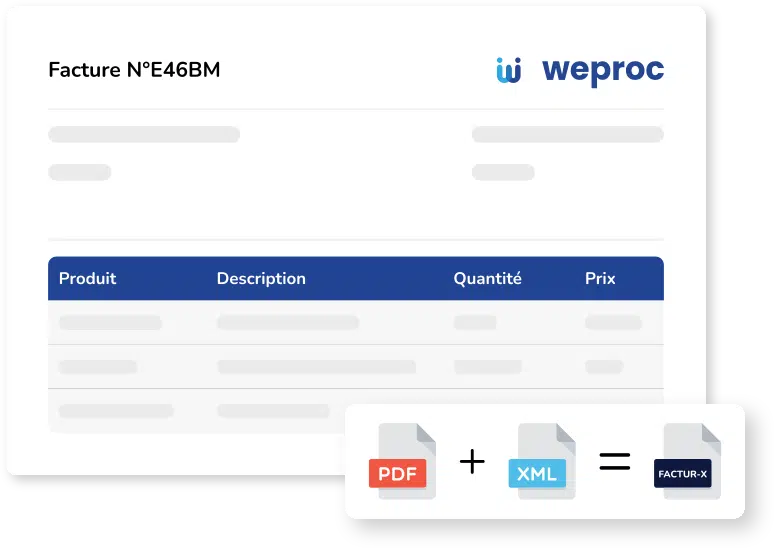
Factur-X (PDF/A-3 + XML CII, Franco-German format according to EN 16931)
-
UBL and CII (European Structured Syntaxes)
These formats ensure the interoperability and automation of purchasing/accounting data.
Each invoice follows a standardised life cycle. Weproc PA Connect issues and synchronizes statuses (mandatory, recommended, free), e.g.:
- filed,
- Availability,
- rejected (technical),
- refused (trades),
- payment transmitted,
- cashed in
in order to offer shared traceability and feed the pre-filled VAT.
In the event of an anomaly (format, mentions, inconsistencies), the invoice is blocked with an explicit status. The teams are notified, the supplier is informed of the cause, and the flow resumes as soon as correction — zero “lost” invoices.
Once made available in Weproc, you trigger the configurable validation workflow (thresholds, delegations, parallelization) and 2-/3-way reconciliation (PO-GR-Invoice).
The objective: to validate quickly, reduce discrepancies, secure accounting exports.
The invoices are broken down to the correct legal and budgetary perimeter. The Provisional Expenditure Plan (Weproc PDP) controls the commitments and blocks validation beyond the envelope if necessary. Consolidated management at group level, exports adapted to the ERP.

Why receiving via a PA is the right first step
- Guaranteed legal framework: role and responsibilities of an AP are defined by the administration; Weproc PA Connect executes these missions and transmits the data to the PPF.
- Up-to-date terminology & schedule: PA (ex-PDP) + Compatible Solutions; Obligations from September 2026 (acceptance for all companies), gradual roll-out.
- Transmission of tax data (e-invoicing & e-reporting) to the Public Invoicing Portal (PPF).
- Tax traceability: shared and reliable statuses, basis for VAT pre-filling.
The DGFiP list specifies that conditional registration is the first step; technical validation (PPF/PA interoperability) completes the final approval — a milestone scheduled by the administration.
September 2026

Mandatory receipt of electronic invoices: all companies
As of 1 September 2026, all companies subject to VAT must be able to receive electronic invoices. In concrete terms, your suppliers issue in structured format (Factur-X/UBL/CII) and the invoice is made available to you via the directory and your Approved Platform. With Weproc PA Connect (your AP), you secure the routing, compliance and monitoring of statuses (provision, refused, payment transmitted, etc.), while preparing the transmission of data to the administration (e-reporting when required). This is the first step in the system: you avoid re-entry, make VAT more reliable and standardise incoming flows.

Issuance + e-reporting: Large Enterprises (GE)
As of September 1, 2026, Large Companies (≥ 5,000 employees or €1.5 billion in turnover > and €2 billion in balance sheet > total) must issue their invoices in electronic format and transmit regulatory data (e-reporting) via an approved platform. Weproc PA Connect orchestrates multi-format issuance, addressing (directory), status publication and data transmission to the PPF, while integrating with your ERP to automate reconciliations and checks. You speed up the billing cycle, while providing the guarantees of authenticity, integrity and readability expected by the administration.

Issuance + e-reporting: Intermediate-sized companies (ETIs)
On the same date, mid-caps (250 to 4,999 employees and turnover ≤ €1.5 billion or balance sheet ≤ €2 billion) also switched to electronic issuance , with obligations to transmit data via a platform. Weproc PA Connect guarantees the compliance of your formats (Factur-X/UBL/CII), the management of rejections/reissues and alignment with your validation workflows and budget rules in Weproc. The result: a “right-first-time” issuance process, a maximum automation rate and real-time management of statuses until payment.

September 2027
Issuance + e-reporting: SMEs, VSEs and micro-enterprises
As of 1 September 2027, the obligation to issue e-invoices extends to all SMEs, VSEs and micro-enterprises. As reception has already been in place since 2026, the challenge becomes structured issuance and data transmission (e-reporting when necessary) without operational disruption. With Weproc PA Connect (PA), you centralize your outgoing invoices, you address your customers correctly via the national directory and you follow shared statuses to reduce disputes and secure your cash flow. The native integration with Weproc (orders, budgets, reconciliations) allows you to industrialize the Purchase-to-Pay cycle while remaining 100% compliant.
The advantages of
e-invoicing
with 
Adopting electronic invoicing with Weproc is much more than compliance: it is a real performance lever for your purchasing, finance and accounting teams.
Thanks to Weproc PA Connect, your Authorized Platform (AP), you centralize the reception and processing of e-invoices while guaranteeing the legal compliance required from September 2026.
- Fewer errors and omissions: invoices are automatically routed to the right department, without the risk of loss or duplication.
- Reduced processing time: an estimated productivity gain of between 40% and 60%, thanks to the elimination of manual entries and reminders.
- Automatic reconciliation and validation: Invoices are compared to purchase orders and receipts, ensuring faster validation and better control of discrepancies.
- Real-time visibility on your commitments: updates your budgets as validations occur and alerts in the event of overruns.
- Guaranteed compliance and traceability: each invoice follows a standardised life cycle (deposited, made available, approved, payment transmitted, collected), offering total transparency of the process.
By choosing Weproc, you simplify your daily life and secure your entire Purchase-to-Pay chain: fewer errors, less friction, more control.
Electronic invoicing becomes a real lever of efficiency for your administrative and financial teams.
Discover all our features
FAQ – Electronic invoicing
Are you preparing to bring your company into compliance with the e-invoicing reform?
Here you will find answers to the most common questions about receiving, issuing and processing supplier electronic invoices.
What is an electronic invoice within the meaning of the French reform?
An electronic invoice is not just a PDF. It is a structured document containing data that can be read by information systems (e.g. Factur-X, UBL, CII), in accordance with the EN 16931 standard.
It must be issued, transmitted and received via an Approved Platform (AP) or the Public Billing Portal (PPF).
This structured format guarantees the automation of processing, the reliability of the data and the traceability of the invoice life cycle
When does e-invoicing become mandatory?
The reform will be applied gradually from 1 September 2026 :
-
All companies must receive e-invoices by this date.
-
Large companies and mid-caps will also have to issue their electronic invoices and transmit their data (e-reporting).
-
SMEs and VSEs will follow on September 1, 2027 for the issue.
This schedule is defined by the DGFiP and aims to digitize the entire B2B invoicing flow in France.
What is the difference between the PPF and an Approved Platform (AP)?
The Public Billing Portal (PPF) is the State’s platform.
Approved Platforms (APs), such as Weproc PA Connect, are private players authorised to issue, receive and transmit e-bills in accordance with the PPF.
They offer extensive functionality, such as compliance monitoring, status tracking, reconciliations, validation workflows , and accounting integration, while ensuring legal compliance and trade security.
What are the main accepted e-invoice formats?
The reform is based on three standardised formats:
-
Factur-X : Hybrid Franco-German format (PDF + XML CII).
-
UBL : European XML format used in many ERPs.
-
CII : Structured syntax in accordance with the EN 16931 semantic model.
These formats allow automatic reading by management software and guarantee interoperability between companies, ERPs and approved platforms.
How does Weproc ensure the compliance of your electronic invoices?
Weproc PA Connect is an Approved Platform (AP) that manages the entire process: reception, issuance, compliance control, monitoring of lifecycle statuses and transmission of data to the administration.
Each invoice follows a mapped path: submitted, made available, approved, payment transmitted, collected.
With the configurable validation workflow and automatic reconciliation, your teams reduce errors and processing times, while remaining 100% compliant.
What concrete benefits does electronic invoicing bring with Weproc?
-
Fewer errors : Data is imported automatically, without re-typing.
-
Time saving : automated validation and reconciliation.
-
Total traceability : monitoring of statuses and conclusive archiving.
-
Budget visibility: automatic update of the Provisional Expenditure Plan (PDP).
-
Guaranteed interoperability : connection to all ERP and multi-company companies.
Electronic invoicing with Weproc becomes a lever for operational efficiency and real-time financial management.