





Accueil » Fonctionnalités (EN) » Project & Job Management
Project & Job Management
Create, track, and easily manage your ongoing projects and jobs.
- Monitor consumption in real time
- Keep an eye on project expenses and purchases
- Manage margins with unmatched accuracy
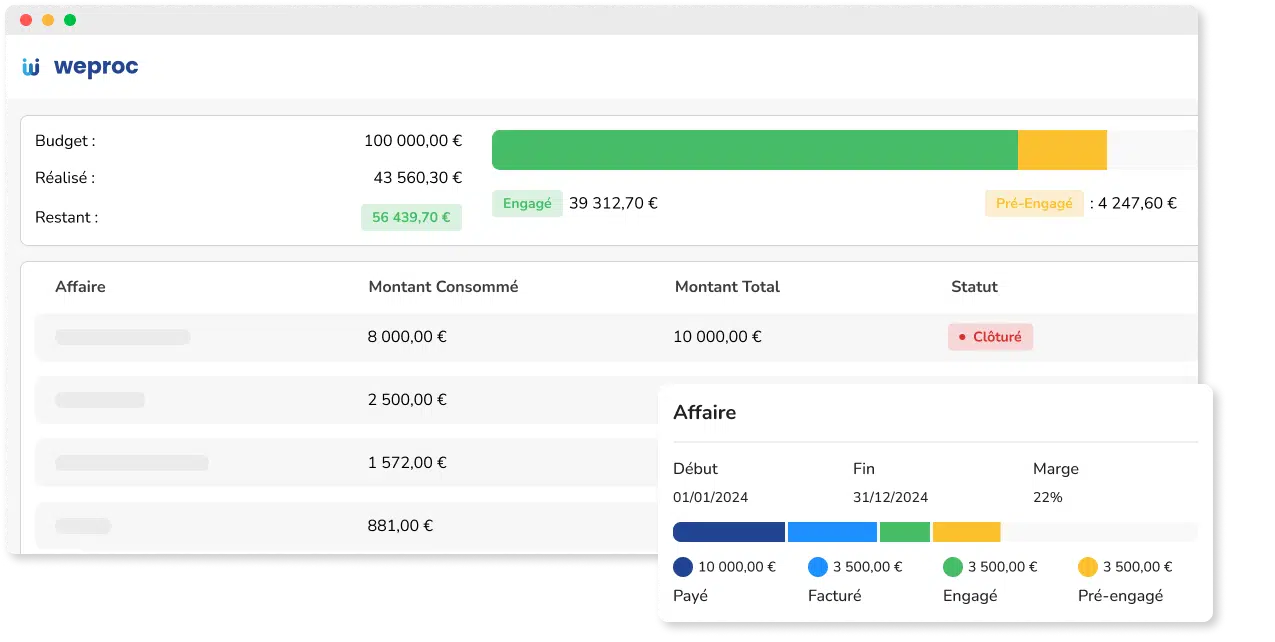
Current Challenges in Budget Management
…………………………………………………………………………………………
Lack of visibility on ongoing costs
Lack of visibility on ongoing costs
Difficulty tracking actual consumption
Difficulty tracking actual consumption
No consolidated analysis across multiple projects
No consolidated analysis across multiple projects
Take Control of Your Projects with Weproc

Complete performance management
Weproc highlights actual costs, projected margins, critical items, and committed expenses. Decisions are based on factual data, not estimates.

Reliable, real-time, total visibility
All project-related data — consumption, purchases, commitments, margins — is centralized in one space. Teams finally work with a single, unified reference.

Simplified operational management
Automated tracking, alerts, and calculations save project managers time, reduce risks, and improve the profitability of every project.

Core Features of the “Projects” Module
Centralize all project-related information
Each project consolidates:
- Consumption
- Committed and pre-committed expenses
- Margins,
- Key dates
- Involved entities
- Associated purchases
- Supplier interventions
No more cross-referencing multiple sources — everything is in one place.
Track consumption in real time
Every order, approval, and invoice automatically updates project consumption. Deviations are detected immediately.
Analyze Project Margins, Project by Project
Weproc automatically calculates:
- Planned cost
- Actual cost
- Outstanding commitments to invoice
- Achieved margin
- Available margin
- Projected variance
Decisions become instant and data-driven.
Compare Projects to Identify Optimization Levers
With a consolidated view, you can compare project performance, detect the most profitable projects, and understand the reasons behind any variances.
Easily Manage Forecasts
Weproc helps anticipate future needs by providing:
- Projection of upcoming consumption
- Analysis of the most impacted cost items
- Simulation of margins under different scenarios
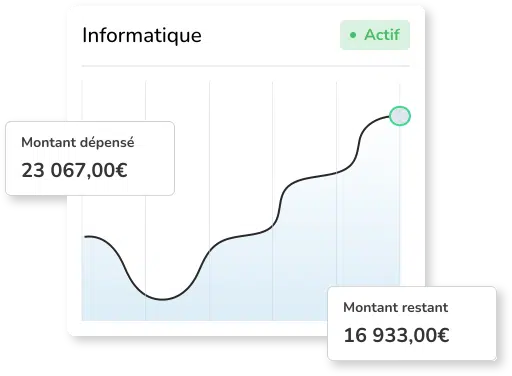
How a Well-Managed Project Works
1. Create your project: define client, dates, budget, and objectives.
2. Assign teams and responsibilities.
3. Associate the budget and cost items.
4. Requests and orders automatically update consumption and margins.
5. Alerts warn of deviations.
6. Track progress, actual costs, and overall performance.
Practical Use Cases of the Budget Tool
The Business tool meets a variety of needs in the field: in industry, it allows you to accurately track costs by site, equipment, operations, labor or supplies. In the construction industry, it offers a complete view of expenses by lot, subcontractor or construction phase. For IT services companies, design offices or consulting firms, it facilitates the management of missions, associated expenses and margins per client or project. Finally, for multi-site groups, it allows you to compare performance between establishments, consolidate data and manage activity centrally.

Margin Calculation & Financial Management
Automatic margin calculation
With every purchase movement, margin indicators update automatically. Project managers gain a clear view of profitability without manual adjustments.
Anticipate financial deviations
Differences between planned and actual costs are immediately visible. Teams can adjust strategies without waiting for month-end reports.
Automated consumption tracking
Each order or approval updates project consumption, cost item by cost item.
Eliminate:
- Manual adjustments
- Project managers’ Excel sheets
- Human errors
- Unjustified deviations


Project-Specific Validation Workflows
Configure approval workflows based on:
- Purchase type
- Amount
- Cost item
- Remaining margin thresholds
Decisions become fast, reliable, and adapted to the context of each project.

Security, Compliance & Governance
Full traceability
All commitments, validations, and modifications are time-stamped and associated with the people concerned.
Anti-over-engagement
You can’t go over envelopes without approval.
Compliance with internal procedures
Each case uses the rules you define: governance, thresholds, channels.

17 % additional margins when a company effectively tracks its projects
FAQ – The Porject Management
Frequently Asked Questions
Have questions? We have the answers!
To effectively manage procurement-related business in a company, it is important to take a structured approach.
With Weproc, it becomes easy to centralize information related to supplier contracts, product and service catalogs, and budgets .
The implementation of validation circuits to organize the purchasing and validation processes will improve communication between the various players and ensure rigorous monitoring of your business.
To measure the performance of business and procurement projects, it is essential to define key performance indicators (KPIs) that are aligned with the company’s objectives. These indicators can include things like cost savings, delivery times, quality of products and services, or relationship with suppliers.
Regular and analytical monitoring of these KPIs will make it possible to identify areas for improvement and optimize the management of business related to the different purchasing families.
In multi-establishment companies, the management of purchasing affairs can be facilitated by the implementation of purchasing software such as Weproc.
With its features, Weproc enables coordination of procurement processes across multiple sites, harmonization of supplier contracts, and sharing of product and service catalogs.
It is also important to track the expenses and performance of your various departments in order to identify opportunities for improvement and cost savings.
To minimize risks in your projects, it is recommended to take a proactive approach and closely monitor market trends, technological developments, and new regulations in force.
It is also important to diversify your supplier portfolio, implement budgets aligned with the company’s actual needs, and regularly monitor the performance of your buyers.
Finally, an approval workflow integrated into your different files helps limit errors and delays in the procurement cycle.
Effective project management offers many advantages for a company, including:
- Cost reduction: by negotiating prices and selecting suppliers that offer the best conditions, a company can achieve significant savings.
- Improved quality of products and services: by working with reliable and high-performing suppliers, the company ensures the quality of the goods and services purchased.
- Process optimization: effective procurement management helps simplify and accelerate supply processes, thereby reducing delays and administrative costs.
- Stronger supplier relationships: by maintaining trust and partnership with suppliers, a company can benefit from better service and favorable purchasing conditions.
- Better risk management: by monitoring supplier performance and diversifying sourcing, a company can reduce risks related to stock shortages, quality issues, or price fluctuations.
Stay Up-to-Date on Catalog Management Best Practices
Discover each week our articles, webinars, or free templates to better manage your projects and procurement activities!

C-class purchases: Everything you need to know about the strategy to adopt.
Applying the Pareto principle to procurement reveals that 20% of the company’s resources generate the majority of its revenue, between 70 and 80%.

Why should we pay closer attention to sustainable procurement?
Discover in this article the reasons to focus on sustainable procurement—purchases that will become increasingly important in the coming years.

How to increase your margins by reducing costs?
To understand why it is the commercial margin that can have more impact than revenue, stay with us until the end of this article.