





Accueil » Procurement Software Features » Spend Category Management
Spend Category Management
Create, track, and manage your spend categories with ease. Make smarter decisions with reliable data.
- Real-time analytics
- Track spend by category
- Monitor spend distribution
- Make informed decisions

Today's Challenges in Procurement Categorization
Most organizations today manage their spend categories using Excel files, shared tools, or scattered information—creating several obstacles:
1) Lack of uniform classification
Each team uses its own logic: different labels, duplicates, inconsistent categories…
This makes it impossible to effectively aggregate spend or analyze trends.
2) No reliable view of spend distribution
Manual spreadsheets make it difficult to accurately track spend by category or identify high-cost areas and budget overruns.
3) Difficulty optimizing budgets
Without clear segmentation, companies struggle to renegotiate contracts, consolidate purchases, or identify opportunities for savings.
4) Time-consuming and inaccurate reporting
Updating spend by category requires hours of manual data entry, with a constant risk of errors or omissions.
5) Limited strategic decision-making
Without structured KPIs, Procurement leadership lacks the visibility to drive strategy, anticipate risks, or align teams.
How Weproc solves these problems
With Weproc, your spend categories become a true strategic asset.
The platform centralizes your categories, automatically updates spend, and gives you a clear, hierarchical view of your expenses.
Structure your spend categories to match your organization, compare expense items in one click, and use dynamic dashboards to analyze trends, control your budgets, and make informed decisions.

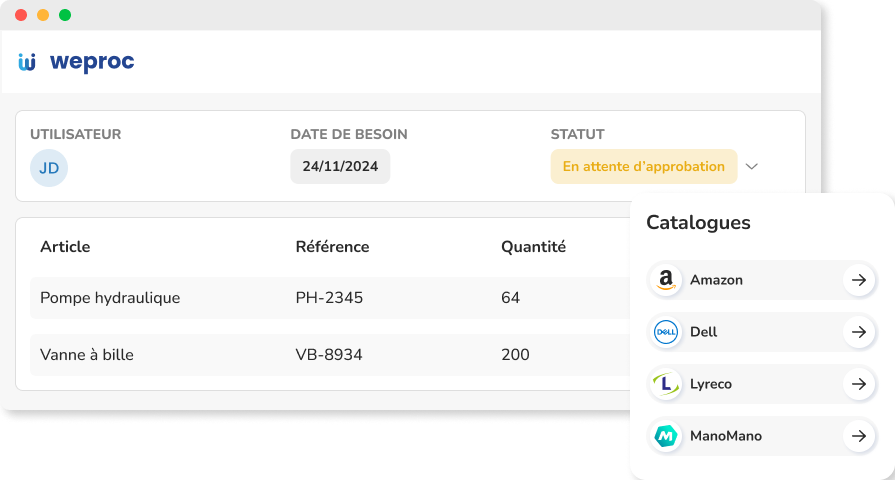
Budget Control
Compare actual vs. forecasted spend by category.
Spot overruns and adjust your purchasing strategy.
Dynamic Reporting
Charts, trend lines, item breakdowns, custom filters…
Turn data into actionable insights.
Core Features for Spend Category Management
Create and Organize Categories
Define your categories and sub-categories based on your internal rules: IT, General Services, Logistics, Marketing, Maintenance…
Weproc adapts to your structure, not the other way around.
Automatic Spend Updates
Every purchase order placed instantly updates the relevant category.
Stop using Excel: your data is reliable, standardized, and ready for analysis.
Spend Analysis by Category
Instantly identify the highest-spending categories, year-over-year variations, purchasing trends, or spending anomalies.
Your decisions become simple, fast, and data-driven.
Intelligent Segmentation
Link products, services, suppliers, and contracts to each category.
Reports, comparisons, and consolidated views are populated automatically.
Spend Analysis
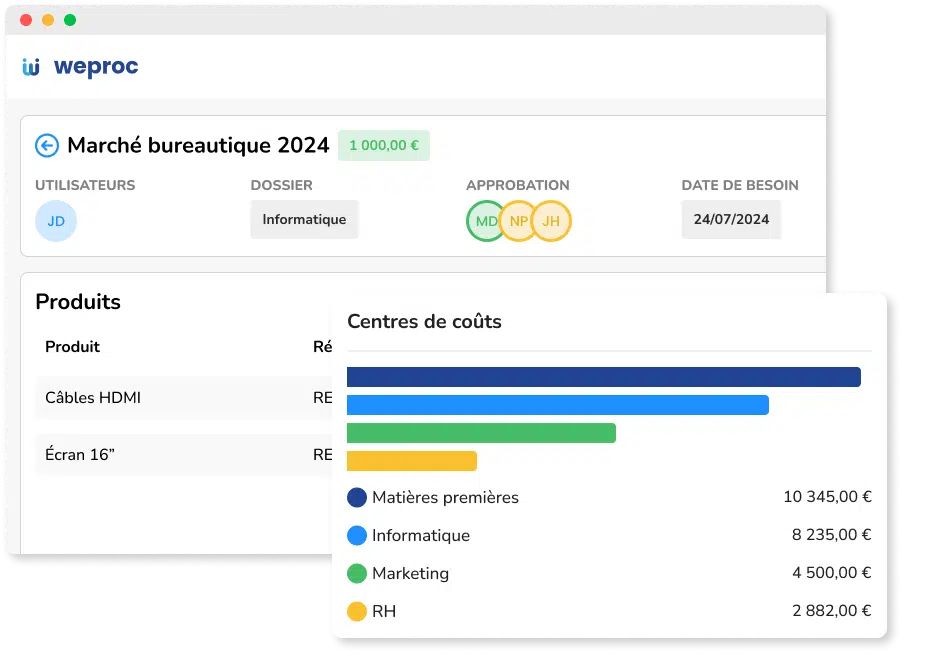
Easily analyze the distribution and evolution of your spend.
Visualize the spend distribution by category, compare trends, and identify savings opportunities in seconds.
Weproc provides you with key indicators:
- Spend distribution by category
- Trends
- Annual variations
- Identification of critical items
- Spend tracking by supplier
- Alerts and overruns
Your decisions become fast, data-backed, and aligned with your procurement strategy.


Use Cases
Mid-Market & Enterprise
A single, harmonized procurement repository, even in complex organizations.
Multi-Site & Multi-Entity
Standardize your spend categories and ensure consistency across all locations.
Indirect Spend
Better understand, manage, and reduce the spend that is often the hardest to control.
Regulated Industries
Get full traceability and reporting that complies with your internal obligations.
Key Benefits
✔ Total visibility into your spend: Compare spend categories, spot anomalies, and manage your main budget items.
✔ Decisions based on reliable data: Weproc transforms your purchasing flows into easy-to-analyze information.
✔ Essential standardization: Eliminate rogue classifications and build a sustainable procurement framework.
✔ Better supplier negotiations: Leverage consolidated volumes and a clear view of your needs.
✔ Automatic, real-time reporting: No more manual entry, no more errors. Spend your time on analysis, not formatting.
13% annual savings on procurement when a company has visibility into its spend distribution.
How do spend categories work?
1. Configure your categories
Simply define your categories based on your internal needs.
2. Link products, services, and suppliers
Connect them automatically or manually, based on your preference.
3. Let Weproc update your spend
Every purchase order feeds your analytics in real time.
Make strategic decisions in real time
Make strategic decisions in real time
With dynamic reporting, you can instantly identify:
- Categories to optimize
- The company’s real needs
- Overspending categories
- Consolidation opportunities
- Budgets to rebalance
You gain visibility, control, and efficiency.
Create approval workflows based on the nature of your purchase
Weproc allows you to create custom approval workflows based on the spend categories affected by your expenses. The relevant stakeholders are notified in real time, speeding up the approval process.

Complementary Modules
Weproc is modular, covering every step of the process: Purchase Requisitions, Sourcing, Contracts, Invoices & Payments, Budgets, Inventory, and more. Build your Source-to-Pay journey at your own pace, without the complexity.

Supplier Management

Contract Management
Link your catalogs to contracts to ensure compliance with negotiated pricing.

Catalog Management
Centralize your products and services in a catalog for simplified order management.
FAQ – Feature: Spend Categories
Frequently Asked Questions
Have questions? We have answers!
A spend category is a grouping of similar or complementary products or services that a company typically purchases together.
Managing spend categories helps to better organize and track expenses, facilitate negotiations with suppliers, and optimize purchasing processes. By grouping purchases into categories, companies can identify synergies and opportunities for economies of scale, while improving coordination between departments.
To determine the right spend categories for your business, you need to consider several factors, such as the specific needs of your departments, your product or service catalog, and the characteristics of your suppliers.
A thorough analysis of your expenses and purchasing processes can help identify the most relevant groupings. It is also important to consult with internal and external stakeholders to get feedback and better understand the challenges associated with each spend category.
To optimize spend category management in your company, it’s essential to adopt a structured, analytics-driven approach. This involves implementing suitable tracking and reporting tools like Weproc, setting clear and measurable objectives for each spend category, and establishing effective coordination and communication mechanisms between the relevant departments.
Implementing framework agreements with key suppliers and streamlining product and service catalogs can also help improve the efficiency of managing business projects and cases by spend category.
To adapt spend category management to a multi-entity context, it is important to consider the specific needs of each location while ensuring overall coordination and harmonization of purchasing processes using custom workflows.
This can be achieved by implementing a centralized procurement management system, which allows for sharing information and best practices between different locations, and by defining common procedures and rules adapted to both local and global constraints.
With its many features, Weproc is the perfect solution for this need!
To track and analyze the performance of your spend category management, it is essential to define key performance indicators (KPIs) tailored to each category and your company’s objectives.
These indicators can include cost savings, budget compliance, product quality, and delivery times.
Want to learn more about spend management?
Discover our weekly articles, webinars, and free templates to improve your procurement management!

Indirect Spend: Definition, Strategic Challenges, and Optimization
Understanding its nature, identifying its challenges, and mastering optimization strategies has become a necessity for any company aiming for excellence and competitiveness in 2026.

Types and Categories of Business Procurement: Optimization Strategies
A deep understanding of the different types and categories of procurement is essential for any company looking to optimize its spending, manage risks, and create value.

Spend Mapping: Managing Spend and Controlling Commitments
This article explores spend mapping in depth, from its definitions to its concrete benefits, including the steps for its creation and the tools that facilitate its maintenance.