

At Weproc, we know an optimized supplier database is crucial. For procurement professionals, it’s the foundation for acquiring essential goods and services that drive success. Yet, managing a growing supplier panel quickly becomes a time-consuming challenge, especially with more partners and contracts to track.
In today’s demanding economic environment, where operational efficiency and cost control are paramount, a streamlined supplier database is a strategic necessity, not a luxury. It transforms daily challenges into opportunities for continuous improvement and value creation.
This article shares proven strategies and best practices for streamlining your supplier databases. By adopting these guidelines, you’ll reduce the time and resources spent managing partners. You’ll also significantly improve overall procurement performance and strengthen your company’s financial health.
⏱️ Key Takeaways in 2 Minutes
- The supplier database is an essential strategic tool for Procurement and Finance departments, directly impacting operational and financial performance.
- Managing suppliers via Excel is a starting solution, but it quickly reaches its limits as modern organizations grow and require advanced analytics, security, and automation.
- Choosing a dedicated supplier management software (like Weproc) automates processes, provides complete visibility, improves collaboration, and optimizes procurement performance with reliable, centralized data.
The Essential Supplier Database
Definition and Strategic Role
At its core, a supplier database is a centralized, organized repository of all relevant information about a company’s business partners. It acts as an intelligent directory, designed to facilitate searching, analyzing, and managing every supplier interaction. Beyond a simple contact list, this database holds crucial details that influence every stage of the procurement cycle, from initial selection to ongoing performance evaluation.
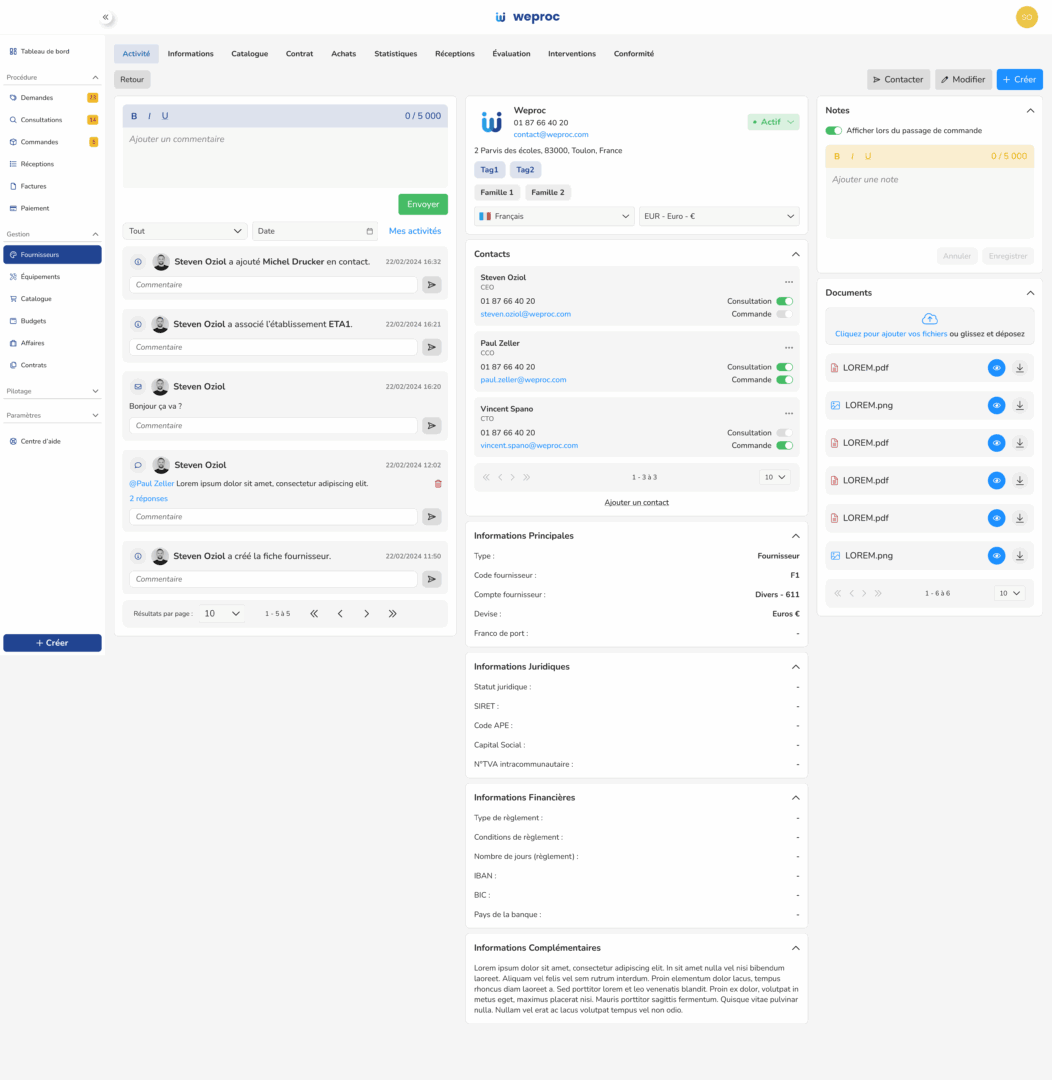
Its strategic role is central to procurement processes. It gives teams a 360-degree view of their supplier panel, enabling informed decisions on RFQs, contract negotiations, and risk management. Without a structured database, buyers would navigate disparate information, leading to delays, errors, and missed opportunities. It’s the backbone supporting efficient and responsive procurement operations.
The financial impact is also significant. Optimized supplier management through an effective database helps identify best pricing, consolidate purchase volumes for better discounts, reduce indirect costs from manual processes, and avoid overspending due to order errors or delivery delays. It directly improves gross margin, optimizes working capital, and secures company financial flows. In short, a supplier database is not just a procurement tool; it’s a lever for overall financial performance.
Why a Structured Supplier Database is Crucial
Adopting a structured supplier database is more than a convenience; it’s a strategic decision that yields substantial operational efficiency gains. First, it centralizes information. Instead of searching across spreadsheets, scattered emails, or physical files, everything is accessible in one place. This centralization drastically reduces search time, minimizes data entry errors, and ensures every team member works with the same up-to-date data. This accelerates and streamlines new supplier onboarding, order placement, and dispute management.
Second, a structured database significantly improves decision-making. With access to accurate, complete, and easily searchable data (order history, performance, contract terms), buyers and finance managers can quickly assess risks, identify negotiation opportunities, compare supplier performance, and choose the most strategic partners. This shifts from a reactive approach to a proactive strategy, based on concrete facts and in-depth analysis. Decisions become more informed, faster, and more relevant to achieving company goals.
Finally, a well-organized database is essential for reducing supplier-related risks. Whether financial (supplier failure), operational (delivery delays, non-compliance), reputational (unethical supplier), or compliance (regulatory non-adherence), a structured database tracks certifications, assesses partner financial health, monitors performance indicators, and anticipates potential issues. With this information readily available, companies can implement emergency plans, diversify supply sources, or enhance critical supplier oversight, thereby limiting the negative impact of any incident.
Challenges of Inefficient Management
Inefficient supplier database management can quickly become an Achilles’ heel for any organization. One of the most glaring challenges is a lack of global visibility. Without a centralized, up-to-date repository, tracking all suppliers and understanding their relevant details becomes extremely difficult. Where is the main contact? What specific products or services does this supplier offer? What are their payment terms? What is their recent performance? These simple questions can remain unanswered or require tedious, time-consuming searches, preventing a clear understanding of the entire supplier panel.
The second major challenge is the proliferation of data inconsistencies and duplications. When supplier information is scattered across multiple systems, spreadsheets, or even individual inboxes, errors and duplicates are inevitable. The same supplier might be recorded under slightly different names, with outdated addresses or incorrect contacts. These inconsistencies make data unreliable, complicate spend consolidation, skew analyses, and can lead to erroneous payments or duplicate orders. Teams then waste valuable time manually checking and correcting these errors, instead of focusing on higher-value tasks.
Finally, inefficient management makes supplier performance tracking extremely difficult. If data isn’t regularly updated or key indicators aren’t centralized, objectively evaluating service quality, delivery times, or contractual compliance becomes impossible. Performance issues can then persist undetected, leading to supply chain delays, reduced quality of final products or services, and customer dissatisfaction. Without this tracking capability, the organization misses crucial opportunities to identify and resolve problems, negotiate better terms, or develop strategic partnerships based on proven performance.
Key Components of a High-Performing Supplier Database
Essential Information to Collect
For a supplier database to be truly effective, it must be rich, structured, and relevant. Here are the essential data categories to collect for each business partner:
- Supplier Master Data: This forms the core of any supplier profile. It includes the company’s legal name, full address (headquarters and separate delivery/billing addresses), company registration number (e.g., SIRET/SIREN for France), VAT number, primary contact(s) (name, title, phone, email), and website. This information ensures unique identification and facilitates communication.
- Products or Services Offered: Detail the goods or services the supplier can provide. This includes product catalogs, service descriptions, standard price lists, internal and external item codes, and any relevant technical or commercial specifications. This section helps quickly understand what can be purchased from this supplier.
- Commercial and Financial Terms: This section is critical for procurement and finance teams. It must include payment terms (deadlines, early payment discounts, preferred payment method), delivery terms (Incoterms, standard lead times), specific pricing structures, minimum order quantities, and any particular contractual clauses. This data is fundamental for cash flow management and cost optimization.
- Certifications and Compliance: For certain industries, specific certifications are a prerequisite. These can include quality (ISO 9001), environmental (ISO 14001), security (ISO 27001), sectoral (automotive, aerospace, food), or CSR labels. The database must record these certifications, their validity dates, and associated supporting documents, ensuring regulatory and ethical compliance of the supplier panel.
- History and Performance Evaluation: A good database goes beyond static data. It must integrate interaction history (past orders, deliveries, incidents) and, crucially, performance evaluation results. These evaluations can cover aspects like product/service quality, on-time delivery, customer service responsiveness, flexibility, and pricing competitiveness. Internal user feedback and Key Performance Indicators (KPIs) are valuable for this section, helping identify the most reliable and high-performing suppliers.

Methods to Enrich and Maintain Data Quality
Collecting initial information is the first step, but enriching and maintaining data quality is an ongoing process. This is essential for the reliability and relevance of your supplier database. Here are key methods to achieve this:
- In-depth Online Research: The web is a trove of information. Regularly research your potential and existing suppliers. Visit their websites for the latest updates on products, services, certifications, and news. Check press articles, industry reports, and professional social media profiles (e.g., LinkedIn) for insights into their financial health, reputation, or CSR initiatives. This information can significantly enrich your understanding and risk assessment.
- Regular Supplier Surveys: Don’t just passively collect data. Actively engage your suppliers by sending them regular surveys or questionnaires. These surveys can cover specific offer details, production capabilities, development plans, internal policies (quality, CSR, security), or updates to their contact information and certifications. This is a direct way to obtain precise information, validated by the source itself.
- Internal User Feedback: Employees who interact daily with suppliers (production, logistics, customer service, end-users) are an invaluable source of information. Establish channels to gather their feedback: an internal evaluation system, regular meetings, or a simple form. Their comments on product/service quality, on-time delivery, support responsiveness, or ease of collaboration can provide valuable, practical insights, complementing objective data.
- Regular Information Updates: A database is a living entity. It must be proactively and regularly updated. Establish a review schedule for key information (certification validity, contract renewals, pricing term revisions). Changes in contact details, legal status, or contacts must be recorded upon notification. It’s crucial to understand that an outdated database with incorrect or obsolete information quickly becomes procurement’s number one enemy, leading to costly errors and a loss of credibility. Clear update validation processes are vital to ensure data accuracy.
Methodology for Building and Streamlining Your Supplier Database
Building and streamlining a supplier database isn’t random. It follows a structured, step-by-step approach, ensuring the tool’s effectiveness and longevity. Here’s a four-key-step process for optimized supplier management:
Step 1: Define Your Management Strategy
Before any technical action, define a clear supplier management strategy. This involves answering fundamental questions that will guide all subsequent steps. What are the key criteria for supplier selection and evaluation? Are they price, quality, delivery times, innovation capability, or CSR commitment? Each organization will have different priorities based on its strategic objectives. Identifying these criteria upfront helps build a database that collects the most relevant information for these evaluations.
Next, what are the expected outcomes and benefits of an optimized procurement process? Is it cost reduction, quality improvement, supply chain security, or regulatory compliance? A clear vision of the final objectives helps structure data and processes to achieve these benefits. Finally, it’s crucial to analyze the risks and challenges associated with supplier management in your specific context (supply disruption risks, financial risks, geopolitical risks). With a well-defined supplier management strategy, you ensure your procurement process fully aligns with your organization’s goals, enabling more informed decisions in partner selection and management.
Step 2: Consolidate and Standardize Data
One of the most common challenges in supplier database management is scattered information. Too often, data is spread across various spreadsheets, departmental databases, or outdated systems, making consultation and analysis tedious. The crucial step here is to gather all your supplier information into a single, centralized repository, easily accessible to all relevant teams (Procurement, Finance, Operations). This repository can be dedicated procurement software (like Weproc), a specific module within an ERP (Enterprise Resource Planning), or a robust, customized supplier profile.
Once data is consolidated, standardization becomes paramount. This involves creating a uniform set of data fields for all supplier information. For example, all company names must follow the same format, addresses should be consistently structured, and contacts must always include name, title, email, and phone in dedicated fields. This standardization ensures your supplier information is consistent and accurate, greatly facilitating searching, sorting, analysis, and reporting. Standardized data forms the basis for efficient operations and minimizes the risk of errors and confusion.

Step 3: Regularly Cleanse Data
Data consolidation and standardization are excellent first steps, but your database’s integrity cannot be maintained without regular, rigorous cleansing. As you gather and harmonize information, you’ll likely encounter duplicates, data entry errors, obsolete, or missing information. Ignoring these ‘impurities’ will inevitably lead to erroneous decisions and a loss of confidence in the database.
The cleansing process involves several key actions: identifying and correcting errors (typos, incorrect phone numbers, malformed addresses), deleting duplicates (when the same supplier appears multiple times under different identifiers), and updating obsolete information (old contact details, changed legal statuses, expired certifications). Data cleansing must be a continuous process, not a one-time event. By integrating this step into your management routine, you ensure your supplier database remains up-to-date, accurate, and reliable, which is fundamental for improving your procurement performance and the relevance of your analyses.
Step 4: Automate Management Processes
The final and most transformative step in streamlining your supplier database is automation. In the digital age, relying on manual processes for daily supplier management leads to inefficiency, errors, and hidden costs. Automation significantly reduces the time and effort spent on repetitive tasks, freeing up teams for higher-value activities.
Automation can be applied to various aspects of supplier management:
- Supplier Onboarding: Dedicated platforms can automate the collection of legal, financial, and compliance documents, information verification, and supplier profile creation.
- Contract Management: Automation tracks expiry dates, generates renewal alerts, and centralizes contractual clauses.
- Invoice Processing: Automated solutions can match invoices with purchase orders and goods receipts, accelerating the validation and payment process.
- Automated Performance Evaluation: Tools can automatically collect data on delivery times and quality, generating performance reports that facilitate analysis and supplier feedback.
By automating these tasks, you ensure your procurement process is more effective and efficient. You also guarantee your database remains dynamic, up-to-date, and ready to support strategic decisions.
Excel: A Starting Point, Not a Final Destination
Initial Advantages of Management via Excel
For many companies, especially SMBs or early-stage startups, Microsoft Excel is the natural starting point for supplier management. This ‘old reliable’ of the business world offers several initial advantages explaining its popularity. The first and most obvious is its ease of learning and use. With its intuitive interface and numerous free online tutorials, a user can quickly create a basic spreadsheet to track initial suppliers and their spend. No advanced technical skills are needed to get started.
Second, Excel is highly customizable. Part of its appeal lies in its flexibility. You can create columns for any type of information (supplier name, contact, products, prices, order date) and organize data according to your specific needs. Whether for profit reports, inventory management, or spend tracking, Excel adapts to a wide variety of uses, including supplier management, allowing on-the-fly customization without heavy software constraints.
Accessible cost is another significant advantage. Excel is part of the Microsoft Office suite, software most businesses already pay for and use daily. Thus, there are no direct additional costs for using it as a supplier management tool, which is especially attractive for limited budgets. Finally, its near-universal recognition means ‘almost everyone knows how to use Excel.’ This familiarity makes sharing spreadsheets with team members or stakeholders extremely easy. Even if another user doesn’t have Excel, other programs like OpenOffice or Google Sheets can open and edit .xls or .xlsx files, facilitating initial collaboration.
| Advantages of Excel for Supplier Management (Initial Phase) |
|---|
| Ease of Learning and Use: Quick learning curve, intuitive handling. |
| Highly Customizable: Flexibility to create fields and organize data as needed. |
| Accessible Pricing: Often included in existing office suites, no direct additional cost. |
| Familiarity and Accessibility: Widespread Excel knowledge within teams, facilitates sharing and collaboration. |
Excel’s Limitations as Your Business Grows
While Excel is an excellent starting point, it quickly reaches its limits as your supplier base expands and business requirements evolve. The main constraint is that data is static and requires intensive manual verification. Every modification, information addition, or update must be done manually. This time-consuming supplier data entry and verification is not only inefficient; it’s also prone to human errors, which can have significant repercussions on operations and finance.
Data security is another major concern. Storing all your supplier data, often sensitive and confidential, in an Excel spreadsheet poses considerable risks. A computer crash, a corrupted file, accidental deletion, or unauthorized access can lead to the loss of hours of work, critical data, and compromise information confidentiality. Excel does not offer the levels of security, change traceability, and access rights management that a dedicated system could guarantee.
Furthermore, Excel suffers from a glaring lack of advanced analytical capabilities. It was designed as a calculation and spreadsheet tool, not a strategic analysis tool. Once your supplier management program reaches the stage where you need forecast ranges, simulation scenarios, complex modeling, planning, or replanning, you’ll find these features far exceed the software’s capabilities. Extracting relevant dashboards, visualizing trends, or creating cross-reports becomes a real headache, limiting the ability to make proactive decisions.
Finally, reliance on a single employee’s knowledge is a significant operational risk. Often, one or two people are the ‘guardians’ of the Excel supplier management sheet, holding expertise on its structure, macros, and peculiarities. If this employee leaves the company, critical process and data knowledge can depart with them, leaving a void and difficulties for successors to take over. A spreadsheet cannot replace a structured system that integrates processes and knowledge sustainably within the organization.
| Disadvantages of Excel for Supplier Management (Growth Phase) |
|---|
| Static Data and Manual Verification: Repetitive entry, high risk of human errors. |
| Data Security Risks: Vulnerability to loss, corruption, and unauthorized access. |
| Lack of Advanced Analytical Capabilities: Not designed for modeling, complex forecasting, or dynamic dashboards. |
| Reliance on Single Employee Knowledge: Loss of critical expertise if key personnel leave. |
When to Transition to an Advanced Solution
Knowing when to migrate from Excel to a more robust supplier management solution is a strategic question for Procurement and Finance departments. The decision often arises when Excel’s limitations begin to hinder operational performance and decision-making. Here are key questions to ask to assess this critical threshold:
- Are you losing significant time manually entering and verifying data? If your teams spend hours or even days on repetitive administrative tasks like entering, correcting, or updating supplier information, that’s a clear signal. This time could be better invested in higher-value activities such as negotiation, strategic analysis, or supplier relationship management.
- Do you need to analyze your supplier data to achieve strategic objectives? If access to detailed statistical reports, dynamic Key Performance Indicators (KPIs), risk analyses, or modeling tools has become a necessity to drive your procurement, optimize costs, or secure your supply chain, Excel will no longer suffice. The increasing complexity of data and the need for business intelligence require tools specifically designed for analysis.
- Is Excel simply no longer robust enough to meet your company’s growing needs? This question encompasses several issues: Has your supplier panel exploded in size? Has collaboration between different departments become chaotic due to multiple versions of the same file? Is the security of your sensitive data at risk? Is regulatory compliance difficult to prove with a spreadsheet? If Excel can no longer support your organization’s scale, complexity, and security requirements, it’s time to consider a dedicated solution.
If the answer to one or more of these questions is ‘yes,’ then your supplier management system has likely outgrown Excel’s capabilities, and it’s time to consider transitioning to a more advanced and powerful solution.
The Revolution of Supplier Management Software
Capabilities of Modern Solutions
Transitioning from Excel to supplier management software represents a true revolution for Procurement and Finance departments. These modern solutions offer capabilities far beyond simple record-keeping, radically transforming how companies interact with business partners and manage their supplies. They are designed to provide unparalleled efficiency, visibility, and control.
- Centralized Contract Management: No more contracts scattered in physical folders or shared drives. Supplier management software centralizes the entire contract lifecycle, from creation to renewal. It tracks expiry dates, sends automatic renewal alerts, provides quick access to specific clauses, and archives all versions. This comprehensive view eliminates the risk of missing important information, losing negotiation opportunities, or ending up with expired contracts.

- Advanced Data Analytics Features: Unlike Excel, these platforms are powerful analytical tools. They explore your supplier’s statistical reports with a variety of Key Performance Indicators (KPIs): on-time delivery rates, product/service quality, responsiveness, contractual compliance, and much more. They offer interactive dashboards, modeling, and forecasting tools, enabling teams to take control of their supply chain, identify bottlenecks, limit risks, and support proactive procurement strategies.
- Customizable Supplier Profiles: Every supplier is unique, and generic profiles are insufficient. Modern solutions offer in-depth customization of supplier profiles. You get complete, structured access to all your partners’ information: legal data (e.g., Kbis for France), supporting documents (certifications, insurance), detailed contact information, purchase history, and crucially, performance evaluations and internal comments. This granularity allows for detailed knowledge of each supplier and better relationship management.
- Integrated Supplier Portal: This is one of the most significant advancements. A supplier portal is a secure interface where your partners can manage and update their own information (contact details, certifications, product catalogs), submit invoices, respond to RFQs, or check their payment status. This simplified process drastically reduces your team’s administrative burden, accelerates information exchange, and streamlines your supply chain. No more wasting time drafting requests or chasing missing documents.
These capabilities transform the procurement function from an administrative task into a strategic lever, capable of generating substantial savings and strengthening company resilience.
Weproc: Automation for Procurement and Finance
At Weproc, we’ve designed a solution that embodies this supplier management revolution, placing automation at the heart of Procurement and Finance department efficiency. Our software is specifically developed to meet the challenges of modern organizations, offering an integrated, intuitive approach to optimize every facet of the supplier relationship.
Weproc provides automated, comprehensive management of your entire supplier panel. In a few clicks, you can onboard new partners, update their profiles, and track all interactions. No more lengthy, tedious onboarding processes. Our platform simplifies information collection, compliance verification, and the creation of complete supplier profiles, saving you valuable time and ensuring data reliability from the source.
Easy supplier creation and tracking are at the core of our value proposition. Weproc offers customizable profile templates, ensuring all essential information (legal, financial, commercial, performance) is structured and accessible. Supplier statuses, order histories, evaluations, and key documents are centralized, enabling proactive and informed management. Automatic reminders for certification or contract renewals ensure you never miss an important deadline.
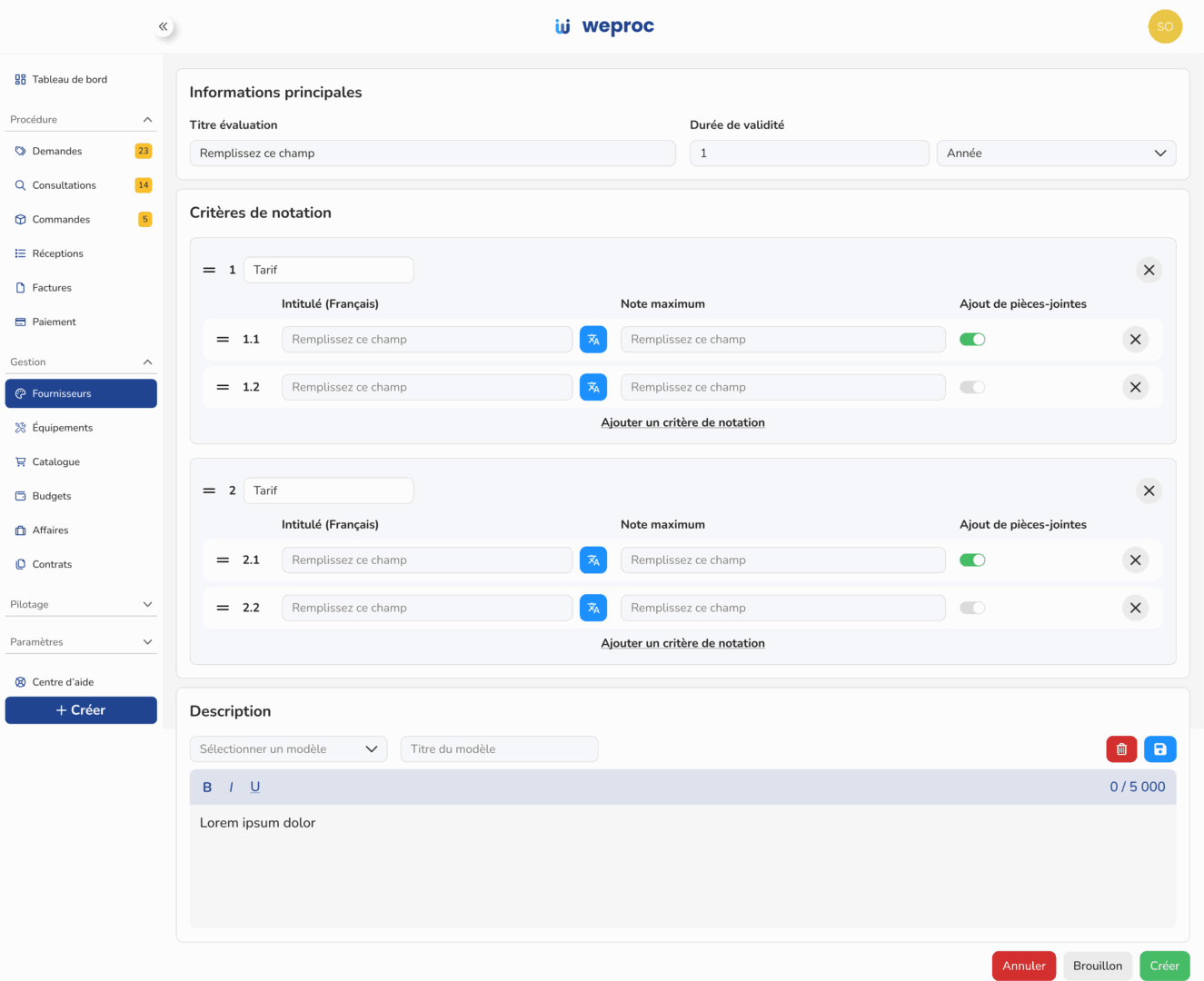
One of Weproc’s major advantages is real-time access to information. Whether current prices, delivery terms, certifications, or performance evaluations, all data is instantly available to Procurement and Finance teams. This real-time visibility enables quick, informed decisions, helps identify the best opportunities, and allows effective reactions to unforeseen events. The Weproc platform is thus an indispensable tool for transforming a complex supplier database into a strategic asset, serving your company’s operational excellence and financial performance.
Go Further: Demo and Resources
Optimizing your supplier database is crucial for the performance of your Procurement and Finance departments. You understand Excel’s limitations and the transformative capabilities of a dedicated solution. The next step is to move from theory to practice.
We warmly invite you to explore the concrete benefits a solution like Weproc can bring to your organization. The best way to understand the power of our software is to see it in action. That’s why we encourage you to request a 15-minute demo. Our experts will be happy to walk you through Weproc’s key features, answer all your questions, and show you how our platform can automate the management of your supplier panel, optimize your purchasing processes, and improve your financial visibility.
For those who want to start structuring their data without waiting to implement a full software solution, Weproc offers practical resources. You can download a supplier database template in .xls format. This free template is designed to help you:
- Save time on the initial setup of your suppliers.
- Share data easily with your teams.
- Track and update your data centrally, even within an Excel environment.
This template gives you a structured framework for starting to organize your information while you prepare to move to a more robust solution. It’s an excellent way to take a first step toward better control over your supplier data.
Finally, to deepen your expertise and stay up to date on industry best practices, we invite you to explore Weproc’s library of resources. Our blog, guides, and white papers are regularly updated with expert articles, case studies, and practical advice for Procurement and Finance professionals. These resources are designed to support you on your journey toward operational excellence and help you master every aspect of managing your business partners.
Don’t wait to transform your supplier management: contact us or request your demo today to discover how Weproc can become your key partner in achieving your strategic goals.